7 Things to Check Before You Buy Golfcore Secondhand
Quick Answer: Check for pilling under the arms and at the hem, test the stretch recovery at the cuffs and waistband, look for a chalky or stiff feel that signals a dead water-repellent finish, inspect the collar for permanent roll, check zippers and logo transfers, and hold light-colored pieces up to the light for thinning. Technical golf fabric ages differently from cotton — it can look pristine on the hanger and be finished as a performance garment.
Golfcore resale is genuinely good value, provided you know that the finish is what you are actually buying.

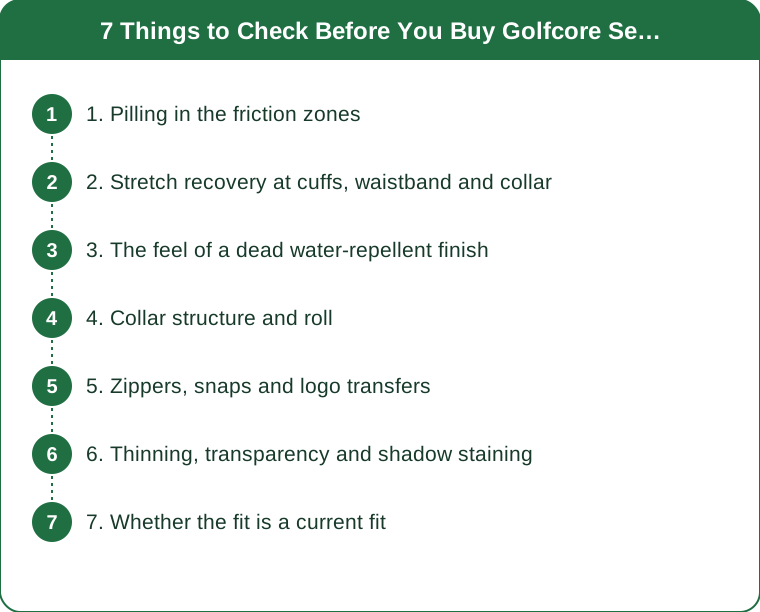
1. Pilling in the friction zones
Look under the arms, along the side seams, at the hem where a bag strap or arm rubs, and across the back where a backpack sits.
Pilling is the visible end of fiber breakdown. On a performance knit it means the surface fibers have already been abraded and the fabric will pill faster from here — abrasion accelerates once it starts. A few pills on the flat of the fabric can be shaved. Dense pilling in a friction zone means the garment is past its useful life.
What is acceptable: light, isolated pilling that comes away cleanly with a fabric shaver.
What is not: a fuzzy halo across an entire panel, or pills that reappear within one wear after shaving.
2. Stretch recovery at cuffs, waistband and collar
This is the fastest ten-second test and the most predictive.
Stretch the cuff or waistband firmly and let it go. It should snap back to its original dimension immediately. If it returns slowly or stays visibly enlarged, the elastane has degraded — most commonly from repeated hot washing or tumble drying — and no amount of care will bring it back.
Why it matters more on golf pieces: performance polos and skorts rely on elastane for both fit and range of motion. A polo with dead cuffs will ride up through the swing, and a skort with a stretched waistband will rotate as you walk.
Worth knowing: elastane degradation is invisible until you test it. A garment can look brand new and have no recovery left.
3. The feel of a dead water-repellent finish
Many technical golf pieces — outer layers, wind shirts, some polos — carry a durable water repellent finish. It wears off, and it wears off long before the garment looks used.
How to check it in the shop: rub the fabric between your fingers. A live finish feels slightly slick and the fabric has a certain crispness. A dead one feels chalky, matte and softer than it should. If you can, put a drop of water on it — a live finish beads, a dead one darkens and soaks in.
Is that a dealbreaker? Not necessarily. Repellent finishes can be reapplied at home with a wash-in or spray-on product for a modest cost, and the result is often close to original. Factor that into the price rather than walking away.

4. Collar structure and roll
The collar is what separates a golf polo that looks intentional from one that looks tired, and it is the part that most reliably fails.
Check whether the collar stands or flops, whether the fold line has become a permanent crease, and whether the underside has discolored. Self-fabric collars on knit polos are the most prone to going soft; woven or ribbed collars hold longer.
A permanent roll cannot be fixed. Pressing it will last until the next wash. If the collar has gone, the piece reads as a worn-out polo regardless of how good the body is — and the collar is the most visible part of a golfcore outfit.
Related check: the placket. Look for stretched buttonholes and puckering along the stitch line, both signs of heavy wear.
5. Zippers, snaps and logo transfers
The hardware and decoration are where secondhand technical pieces most often fail unrepairably.
Zippers: run them fully, twice. Look for a slider that jumps the teeth, a broken tooth, or a pull that has been replaced with a keyring. A quarter-zip with a failing zipper is not economically repairable in most cases.
Snaps: check that each one closes with a firm click. Loose snaps on a skort or shorts waistband will keep opening.
Logo transfers and heat-applied graphics: these crack and peel with washing and heat, and there is no fixing them. Look at the edges — if any corner is lifting, the whole graphic will go within a season. Embroidered logos, by contrast, generally outlast the garment.
6. Thinning, transparency and shadow staining
Hold light-colored pieces up against a window or a bright light.
Thinning shows as a lighter, translucent patch — usually across the seat of skorts and shorts, or across the shoulders where a bag sat. Once fabric has thinned there is no recovery, and it will become sheer.
Shadow staining is the faint discoloration that stays after a stain was removed. Under indoor shop lighting it is often invisible; under daylight on a course it shows clearly. The underarm area of light polos is the usual location, from antiperspirant and sun cream, and it does not wash out.
A note on white: white performance fabric yellows with age and UV exposure, and the yellowing is uneven. Compare the collar underside against the body — if they no longer match, the piece has aged.
7. Whether the fit is a current fit
The last check is about the piece rather than its condition.
Golf apparel silhouettes have moved considerably in the past decade — sleeve length, polo body cut, skort length and rise have all shifted. A perfectly preserved polo from ten seasons ago can be in flawless condition and still read as dated, which is the main way people end up with a closet of good-condition pieces they do not wear.
Quick tests: does the sleeve end at a flattering point rather than mid-bicep drape? Does the body have shape, or is it a straight box? Is the skort rise sitting at the waist or well below? Is the shoulder seam at your actual shoulder?
And the practical one: try it on and make a full swing motion in the fitting room. Golf clothes are the only category where the fitting-room test should include a range-of-motion check, and secondhand pieces with degraded stretch fail it immediately.
FAQ: Secondhand Golfcore Questions, Answered
Which pieces are the best value secondhand?
Outer layers and vests, because they get worn less per season than polos and hold up better. Also skorts and shorts from quality brands, where the construction difference against fast fashion is genuinely visible.
Which pieces should I buy new?
Anything relying heavily on elastane recovery for fit — compression layers, fitted polos in stretchy knits — and anything white. Both age in ways that are hard to assess and impossible to fix.
Is it worth paying for a well-known brand secondhand?
Often yes, because better construction shows up specifically in the parts that fail — collars, zippers, stitch density and elastane quality. A well-made polo at half price with a good collar is a better buy than a new budget one.
TL;DR:
- Check pilling in friction zones, and shave-test whether it comes away cleanly.
- Snap-test the cuffs and waistband — dead elastane is invisible and unfixable.
- A chalky feel means the water-repellent finish is gone, which is reapplyable at home.
- Collars, zippers and heat-applied logos are the unrepairable failure points.
- Hold light pieces to daylight for thinning and shadow staining, and swing-test the fit before buying.
Secondhand golfcore is one of the better value plays in the wardrobe — as long as you shop the finish and the hardware, not just the label.
See It in Motion
Seen here: UPF 50+ Adjustable A-Line Running Skort with Pockets — shop it on bubblelime.com
Keep Reading
This article is for general informational and styling purposes only. Fit, sizing, and product availability may vary.