7 Golfcore Mistakes That Make the Look Read as Costume
Quick Answer: Golfcore works when it borrows the shapes and fabrics of golf clothing and fails when it borrows the signals. Logos, full matching sets, technical performance fabric, and anything that says a specific course or tournament all read as costume. The pieces that work - the polo, the pleated skirt, the knit vest, the fine cable - work because they have independent lives outside golf. Keep one golf reference per outfit and let everything else be ordinary clothing.
Golfcore has been on the runway and on the street for a few seasons now, and the failure mode has become very consistent: it either reads as effortless preppy sportswear, or it reads as someone who got dressed for a scramble and never made it to the course.
The difference comes down to about seven specific choices.
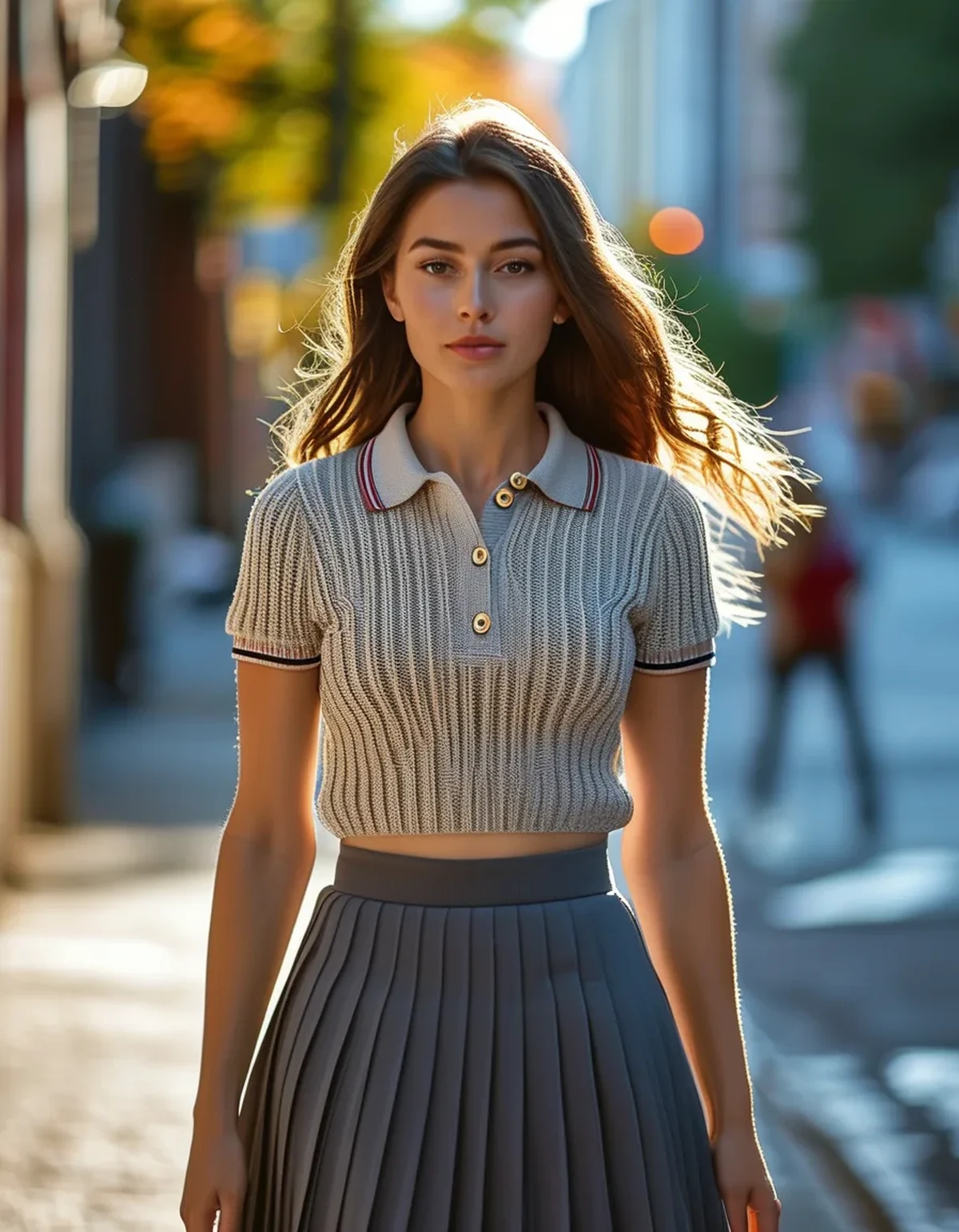
Mistake 1: Wearing the full matching set
The single fastest way to cross from styling into costume.
A coordinated polo and skirt in the same fabric and color, from the same brand, is a uniform - and that is precisely what golf clothing is designed to be. Worn together off the course, it reads as sportswear worn in the wrong place rather than as fashion.
Break the set. The polo works enormously well with denim, with tailored trousers, with a slip skirt, with anything that is not its intended partner. The pleated skirt works with a fine knit, a plain tee, a button-down, a leather jacket.
The rule of thumb that holds up: one golf-signaling item per outfit. Two is a theme. Three is a costume.
The exception is when the set is deliberately not in golf fabric or golf colors - a knit polo and matching knit skirt in cream or chocolate reads as a knit set, not as golf, because the fabric is doing the talking and the fabric is not technical.
Mistake 2: Technical performance fabric
Fabric is what gives it away before the shape does.
Modern golf apparel is made from moisture-wicking polyester with a specific sheen and a specific hand. It photographs with a slight plasticky highlight and it drapes in a way that no natural fiber does. That sheen is legible at ten feet and it is the single most reliable tell.
The golfcore that works is almost entirely in cotton, cotton pique, merino, silk and fine knits. A cotton pique polo and a polyester performance polo are the same garment shape and completely different objects visually.
This extends to the outerwear. A technical quarter-zip in performance fabric reads as gym or course. The same quarter-zip silhouette in merino or a cotton-blend knit reads as clothing.
If you own performance pieces and want to use them, the workaround is to bury the fabric under something matte - a technical polo under a chunky cardigan mostly disappears. But the simpler path is choosing the shape in a natural fiber to begin with.
Mistake 3: Any visible course, tournament or brand logo
A logo turns a reference into a claim.
A plain knit vest is a knit vest. A knit vest with a course crest is a souvenir, and it announces a specific relationship to golf that changes how the whole outfit is read.
This is the difference between borrowing an aesthetic and cosplaying a membership. The aesthetic is available to anyone. The crest is not.
The same applies to technical brand logos on the chest or sleeve, which pull the piece firmly back into sportswear regardless of what else you are wearing.
Small, subtle, non-golf logos are fine. The issue is specifically golf iconography - crossed clubs, course names, tournament years, tee-and-ball motifs. Those are the pieces to wear on the course and not in the city.
Vintage is the interesting exception. A genuinely old, faded club sweater with a worn crest reads as vintage rather than as costume, because age changes the signal from I belong to this club to I found this. But it has to actually look old.

Mistake 4: The wrong shoe
The shoe decides which direction the whole outfit resolves.
A sporty white sneaker with a polo and a pleated skirt pushes the outfit toward athletic, which is the direction that reads as costume. The same outfit with a loafer, a ballet flat, a mary jane or a slim boot resolves as preppy tailoring, which is the direction that works.
This is the highest-leverage single change in the entire aesthetic. If one thing in this list is worth acting on, it is the shoe.
The reason is that golf is a sport, and sport clothing is read through footwear more than through anything else. Break the athletic footwear signal and everything above it gets re-read.
The exception is a plain, flat, non-technical sneaker - a canvas or leather low profile with no visible sport engineering. That still reads as clothing. A running-shaped sneaker with a chunky sole does not.
Mistake 5: Matching the socks to the theme
Tall white athletic socks with a pleated skirt is a specific look, and it is a costume look.
The crew sock has had a genuine fashion moment, but paired with the rest of a golf-referencing outfit it stacks with everything else and tips the balance.
Go the other way. A bare ankle, a sheer sock, a fine ribbed sock in a color that has nothing to do with the outfit - all of these break the theme in a useful way.
This is the general principle of the whole aesthetic in miniature: every element that could read as golf should be asked whether something else could do the job. Usually something else can, and the outfit is better for it.
The same logic applies to the visor and the cap. A cap is fine. A visor is golf. There is almost no context in which a visor reads as anything else.
Mistake 6: Getting the skirt length wrong
The golf skirt has a specific length and copying it is what makes it read as equipment.
Performance golf skirts sit at a particular mid-thigh point designed for a specific range of motion, usually with visible built-in shorts. That length plus that construction is unmistakably functional.
The pleated skirt that works in golfcore is either longer - at or below the knee, in a heavier fabric - or clearly styled as a tennis-adjacent mini with no functional pretensions.
The midi pleated skirt in wool, faux leather or a heavy cotton is doing most of the work in the successful versions of this aesthetic. It carries the pleat reference, which is the visual link to golf, while being obviously a fashion garment.
And the fabric weight matters as much as the length. A pleated skirt in a light technical fabric moves like sportswear. The same pleat in a heavier fabric holds and swings, which reads entirely differently.
Mistake 7: Forgetting that the point is the tension
Golfcore is interesting because it is preppy clothing in a non-preppy context. Remove the tension and there is nothing left.
The versions of this that look best on the street pair the golf reference with something that has no business next to it - a polo with baggy jeans and a heavy boot, a pleated skirt with an oversized leather jacket, an argyle vest with slouchy tailored trousers and a bare shoulder.
When every element agrees with every other element, the outfit becomes an illustration of a category rather than an outfit. The pieces that make it work are usually the ones that do not match.
The practical version: after you have assembled the outfit, identify the one item that would look wrong on a golf course. If you cannot find one, add one.
That single question resolves most golfcore styling problems faster than any rule about colors or lengths - and it is the difference between a look that reads as intentional and one that reads as borrowed.
TL;DR:
- One golf-signaling item per outfit. Two is a theme, three is a costume.
- Natural fibers only - technical polyester sheen is the fastest giveaway.
- No course crests, tournament logos or golf iconography, unless it is genuinely vintage.
- The shoe is the highest-leverage change. Loafers, flats and boots resolve the outfit as tailoring; sport sneakers resolve it as athletic.
- Skip the tall white socks and the visor - they stack with everything else.
- Longer, heavier pleated skirts read as fashion; performance-length ones read as equipment.
- Keep one item that would look wrong on a course. That tension is the entire point.
Golfcore works as a borrowed vocabulary, not as a complete sentence.
See It in Motion
Seen here: UPF 50+ Adjustable A-Line Running Skort with Pockets — shop it on bubblelime.com
Keep Reading
This article is for general informational and styling purposes only. Fit, sizing, and product availability may vary.