7 Golfcore Layers That Actually Work in October — and 3 That Look Wrong
Quick Answer: Golfcore’s core pieces — polos, skorts, pleated skirts — are warm-weather garments, so autumn layering is where the aesthetic either matures or reads as costume. The seven that work: the quarter-zip, the knit vest, the fine-gauge crewneck, the shirt jacket, the pleated midi, the tall sock, and the unstructured cardigan. The three that fail: the performance windbreaker off-course, the puffer vest, and the technical rain shell.
Golfcore looked effortless all summer. Then the temperature dropped and the same pieces started looking like you were on your way to a tournament.
The difference between the pieces that translate and the ones that do not is consistent, and it comes down to fabric.
1. The quarter-zip — the single most versatile piece
Why it works: the quarter-zip is the one genuinely golf-derived garment that reads as normal clothing everywhere. It has a long life in preppy and collegiate dressing entirely independent of golf, which means it carries no costume risk.
What to look for: merino, cotton, or a fine cotton blend. The fabric is the whole decision — a merino quarter-zip is a sweater, and a shiny polyester performance quarter-zip is sportswear. Same silhouette, completely different signal.
How to wear it in October: over a collared shirt with the collar out, with a pleated skirt and tall socks, or with straight trousers and loafers. The collar peeking out of the neckline is the detail that makes it read golfcore rather than generic knitwear.
Colors that work now: cream, camel, forest green, navy, burgundy. Autumn is where golfcore’s color palette actually improves — the summer brights give way to a richer range that suits the aesthetic better.
Why it beats the alternatives: it layers over almost anything, it works alone, it can be pushed up at the sleeves, and it takes a coat over it without bulk.
2. The knit vest — golfcore’s best autumn piece
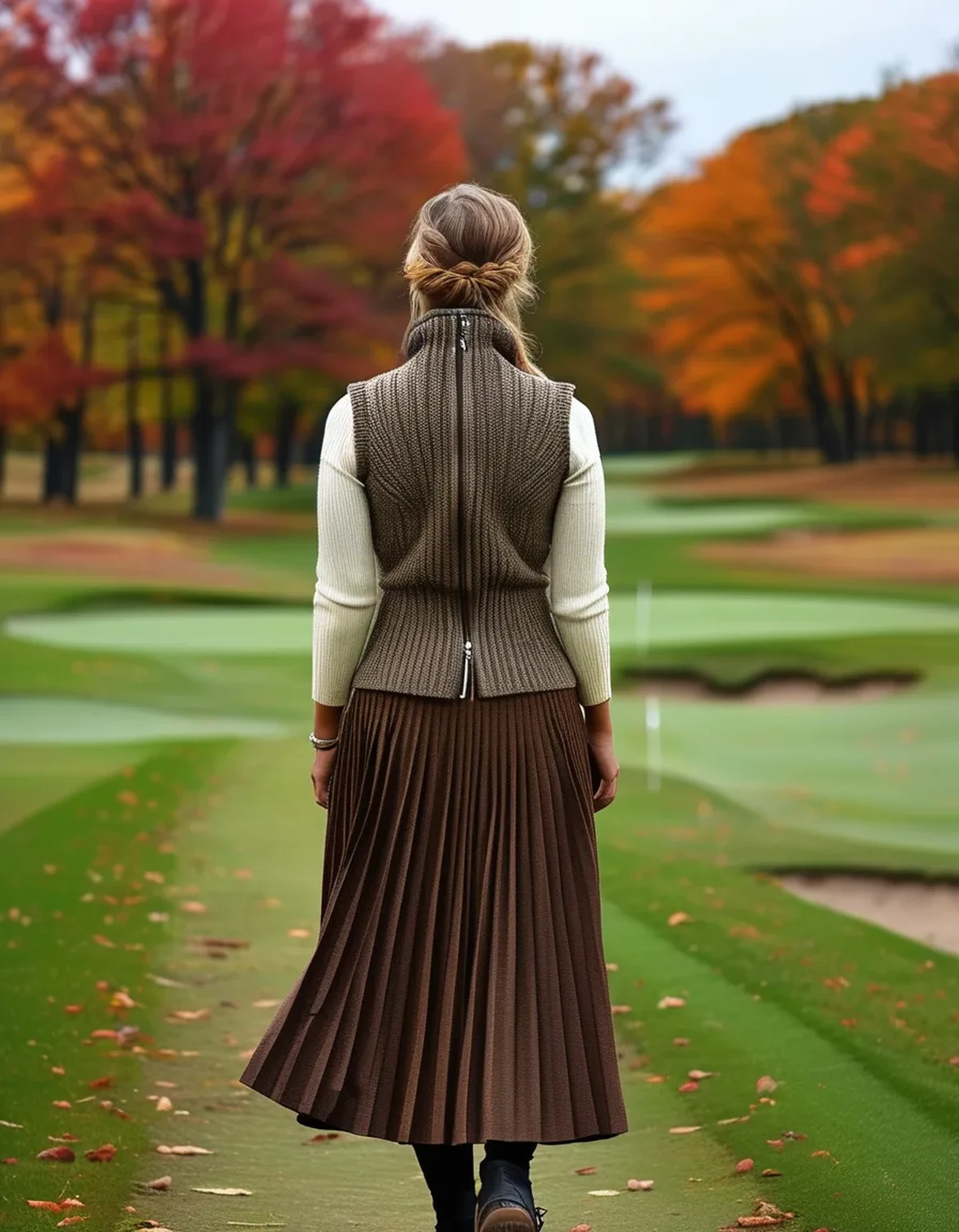
Why it works: the sleeveless knit vest is the most authentically golf-derived layer in the entire aesthetic and simultaneously the most wearable. It has been on golf courses for a century and in general fashion for nearly as long.
What to look for: a fine-gauge knit rather than a chunky one. Cable knit is the classic and it reads more preppy; plain or subtle-textured reads more modern. Argyle is the highest-risk pattern in the category — it is either the best thing in the outfit or it tips straight into costume, with very little in between.
How to wear it: over a collared shirt with the sleeves visible below the vest’s armholes. This is the whole point of the garment — the contrast between the shirt sleeve and the knit body is what makes it work.
The October version: over a long-sleeve shirt rather than a short-sleeve one, with the shirt cuffs showing at the wrist.
The mistake to avoid: a vest that is too long. It should end at or just below the waistband, and a longer one reads as a tunic and loses the proportion entirely.
3. The fine-gauge crewneck
Why it works: it is the least golf-specific piece on this list, which is exactly its value. Every golfcore outfit needs pieces that are just good clothes, or the whole look becomes a theme.
What to look for: merino or cotton, fine gauge, in a solid autumn color. Nothing branded, nothing technical.
How to wear it: the classic move is over a collared shirt with the collar and the shirt hem both visible. That layering — collar out at the top, shirt tail out at the bottom — is doing most of the work and it is the difference between a sweater and an outfit.
With what: pleated skirt and tall socks, or trousers and loafers. A crewneck plus pleated midi plus loafers is arguably the most reliable autumn golfcore outfit there is and it involves no technical fabric at all.
Why fine gauge specifically: a chunky sweater is a different aesthetic entirely. Golfcore’s proportions are neat and slightly formal, and bulk fights that.

4. The shirt jacket
Why it works: it fills the exact gap October creates — warmer than a shirt, lighter than a coat, and it reads as clothing rather than as gear.
What to look for: wool or a wool blend, in a solid, a check, or a subtle plaid. Structured enough to hold its shape, which is what separates a shirt jacket from an oversized flannel.
How to wear it: open, over a polo or a fine knit, with the collar of whatever is underneath visible. It is a layer that works best unbuttoned, which is also why it handles the temperature swings of an autumn day well.
The check question: a windowpane or a subtle tattersall reads country-club and fits perfectly. A heavy buffalo plaid reads outdoor workwear and belongs to a different aesthetic entirely.
Why it beats a blazer here: a blazer is more formal than golfcore actually is. The shirt jacket has the same layering function with a more relaxed register, which is closer to the aesthetic’s actual mood.
5. The pleated midi and 6. The tall sock
The pleated midi — why it works in autumn:
The pleated skirt is golfcore’s signature and it does not need to disappear in October. The change is length and fabric — a midi in a heavier fabric handles autumn where a short pleated skort does not.
What to look for: wool blend, heavier crepe, or a substantial twill. Anything that hangs with weight rather than floating. A summer-weight pleated skirt looks out of season immediately in autumn, and it is the most common seasonal misstep in the aesthetic.
How to wear it: with opaque tights and loafers or ankle boots, plus a knit on top. Tights are what make the pleated skirt work below 60°F, and sheer is the wrong choice here — opaque in black, charcoal, or a deep neutral.
The tall sock — why it works:
Tall socks are genuinely golf-derived and they solve a real autumn problem. Over-the-knee or mid-calf socks with a pleated skirt and loafers covers the leg without tights, and it is the more interesting option.
What to look for: ribbed cotton or wool in cream, grey, navy, or a subtle Fair Isle pattern.
The proportion rule: either the sock or the skirt should be doing the talking, not both. A patterned sock with a plain skirt works. A patterned sock with a patterned skirt is where golfcore turns into a costume most reliably.
7. The unstructured cardigan — and the 3 pieces that fail
7. The unstructured cardigan.
Why it works: it is the softest layer in the category and it prevents an outfit built from crisp collars and pleats from reading stiff. Golfcore’s failure mode is looking too composed, and a relaxed cardigan is the antidote.
What to look for: fine gauge, longer than a cropped cardigan, worn open. Cream, oatmeal, camel, or navy.
How to wear it: open over a collared shirt and a pleated skirt, sleeves pushed up. The looseness is the point — a fitted, buttoned cardigan does the opposite job.
Now the three that fail:
The performance windbreaker, worn off-course. On the course it is correct and functional. Off the course, a shiny technical golf jacket with a brand mark is the single most costume-triggering piece in the category. It reads as sports equipment because it is, and no styling fixes it.
The puffer vest. Popular, warm, and belonging to a different aesthetic entirely. A puffer vest reads outdoor-technical or ski-adjacent, and the quilted volume fights golfcore’s neat proportions. The knit vest does the same job and belongs.
The technical rain shell. Same problem as the windbreaker, more so. Waterproof membranes, taped seams, and hood toggles are gorpcore vocabulary, not golfcore. If you need rain protection off-course, a wool coat or a classic trench sits in the aesthetic properly.
The pattern behind all three: technical fabric is what breaks golfcore. The aesthetic works because it borrows the shapes of golf clothing and executes them in normal materials. The moment the fabric is genuinely performance-oriented, it stops being a reference and becomes actual sportswear.
TL;DR: Fabric decides whether autumn golfcore works. Shapes borrowed from golf, materials borrowed from normal clothes.
- Quarter-zip in merino or cotton, collar out underneath. The most versatile piece in the category.
- Knit vest over a long-sleeve shirt with sleeves and cuffs showing. The most authentically golf-derived and most wearable.
- Fine-gauge crewneck over a collared shirt, collar and hem both visible. Least golf-specific, which is its value.
- Wool shirt jacket, worn open — subtle check, never buffalo plaid.
- Pleated midi in a heavy fabric with opaque tights, or tall socks with loafers. Never both patterned.
- Unstructured cardigan to keep the whole thing from reading stiff.
- Avoid: the performance windbreaker off-course, the puffer vest, and the technical rain shell. All three are actual sportswear rather than references to it.
Check the fabric label before the silhouette. That is the whole rule.
See It in Motion
Seen here: UPF 50+ Pleated Running Skort with 26” Leggings & Pockets — shop similar styles on bubblelime.com
Keep Reading
This article is for general informational and styling purposes only. Fit, sizing, and product availability may vary.