7 Golfcore Details That Signal You Actually Play
Quick Answer: Golfcore reads as authentic or as costume based on details that have nothing to do with branding. The seven that matter: a collar that holds its shape, a hem that stays tucked, shoes with the right sole for the ground you are on, a glove tan or a glove in a pocket, pockets that carry something, fabric that performs rather than imitates, and colour discipline. Get these and the look works even in cheap pieces. Miss them and it reads as fancy dress in expensive ones.
The short version: golf clothing was designed around a set of physical problems - swinging, walking five miles, weather changing over four hours. Details that solve those problems read as real. Details that reference them read as costume.

1. The collar has to hold its shape
This is the first thing anyone notices and the fastest tell in the entire category.
A golf polo collar is constructed. It has interfacing, a proper stand, and often a self-fabric or ribbed edge that keeps it upright through a round in humidity. A fashion polo collar is a folded piece of jersey that goes limp within an hour and stays that way after washing.
Check three things before buying: does the collar stand up on its own when the shirt is on a hanger, does it have a visible stand at the back of the neck, and does the fabric at the collar differ from the body fabric. Two out of three is fine. Zero means it will look tired by lunchtime.
Why it matters visually: the collar frames your face and sits at the highest point of the outfit. A collapsed collar makes the entire look read as soft and unstructured, which is the opposite of what golfcore is doing.
The maintenance side: collars die in the tumble dryer. Hang dry your polos and they hold their structure for years rather than months. This single habit is worth more than doubling your budget.
A note on the alternative: a mock neck or a quarter-zip does the same structural job and is genuinely the more contemporary choice right now. If you have never liked collars, that is the route rather than a soft polo.
2. The hem stays where you put it
The second most visible detail and the one that separates a golf shirt from a t-shirt with a collar.
Golf polos are cut longer at the back. A drop hem, or a curved shirttail hem, exists because you bend forward at address and reach overhead in the follow-through. A straight, cropped hem untucks itself in one swing.
Tucked is the default in golfcore, and that is exactly why the hem matters. A shirt that untucks constantly means either you stop tucking it - which changes the look entirely - or you spend the day adjusting.
The visual logic of the tuck: golfcore relies on a defined waist and a clear proportion between top and bottom. An untucked polo over a skort erases the waist and the whole silhouette collapses into a rectangle.
If you do not want to tuck, the alternative is a piece designed to be worn out - a slightly cropped polo, or a longer polo with side splits. What does not work is a mid-length untucked shirt with no shape, which is the single most common golfcore styling failure.
A practical tip: the French tuck - front only, sides and back left out - works with golfcore and is more forgiving. It keeps the waist definition without needing a shirt that stays perfectly tucked all day.
3. The shoes match the ground you are standing on
This is where the look most often falls apart, and it is entirely fixable.
Spikeless golf shoes are the right answer for golfcore off the course. They read as golf shoes, they walk normally on pavement, and they are genuinely comfortable. Actual spiked shoes worn on a street look wrong and sound wrong, and they damage floors.
A clean, low-profile white leather sneaker also works, and is arguably the more wearable everyday option. The key is low profile - chunky sneakers pull the outfit toward athleisure and away from golfcore entirely.
What does not work: running shoes with visible technical mesh and bright midsoles. They are the strongest single signal that the outfit is a reference rather than a wardrobe, because nobody has ever played golf in them.
Loafers are the sleeper option. A leather loafer with a pleated skort and a polo is closer to the country club original than any sneaker, and it dresses the whole look up without effort. This is the move as the weather cools - loafers with a knee sock or a fine knit sock carry golfcore into autumn better than anything else.
Socks matter more than people expect. Visible athletic crew socks read athleisure; a low ankle sock or a fine knee-high reads golf. This is a very cheap detail with a very large effect.
4. The glove, or where the glove has been
The most specific insider detail in the whole category.
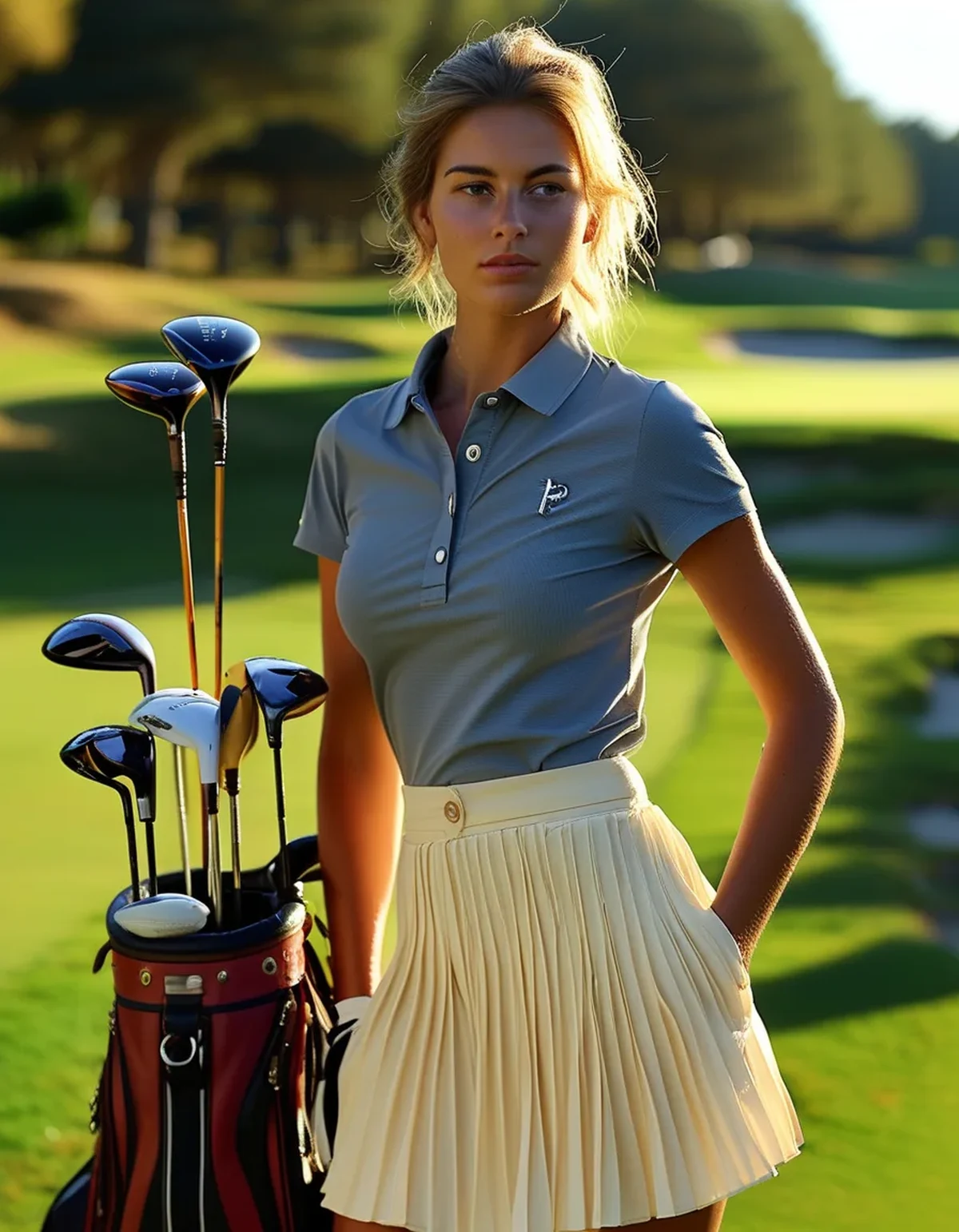
Golfers wear a glove on the lead hand only - left hand for a right-handed player. This produces a genuinely distinctive tan line, and it is instantly recognisable to anyone who plays.
Carrying a glove is the styling version. Tucked into a back pocket, hanging from a bag strap, or held in the hand. It is the single most efficient authenticity signal available and it costs almost nothing.
What does not work: wearing two gloves. It is the giveaway that the reference has been misunderstood, and it is surprisingly common in styled photography.
The bag is the other object detail. If you are photographing golfcore or actually going somewhere golf-adjacent, a real golf bag or a Sunday bag does more for the look than any garment. A Sunday bag - the light, minimal carry bag - is also genuinely attractive as an object.
Other object details that read correctly: a ball marker on a cap, a pencil in a pocket, a divot tool. All small, all specific, and all things a person who plays actually has on them. The principle throughout is that the accessories should be tools, not ornaments.
5. The pockets are doing something
Golf clothing has functional pockets because golfers carry things for four hours, and the difference shows.
Real golf skorts and trousers have deep, secure pockets - often a zip or a snap on at least one - because losing a ball marker or a phone mid-round is a real problem. Fashion versions have shallow decorative pockets or none at all.
The tell when you are shopping: put your hand in. If it does not reach past your wrist, it is decorative. A real golf pocket takes a phone or a scorecard.
Why it changes how the garment looks worn: a functional pocket sits flat and holds shape. A shallow fake pocket gapes and pulls, particularly across the hip.
The tee loop and the ball pocket are the small construction details on real golf trousers and skorts. They do not shout, and they are exactly the kind of thing that makes a garment read as the real object.
A caution: do not overload them. A phone in a skort pocket ruins the line of the garment, which is why golfers put things in the bag. The pockets should be capable of carrying, and mostly carry small things.
6. The fabric performs rather than imitates
The least visible detail and the one that decides whether you will keep wearing the piece.
Golf fabrics are technical for real reasons. Four-way stretch for the rotation of a swing, moisture management for four hours in the sun, UV protection, and enough weight to hang properly rather than cling.
The fashion imitation is usually a thin polyester that looks similar on a hanger and behaves nothing like it worn. It clings, it shows every mark, and it holds odour - the last one being the reason a lot of golfcore purchases quietly stop being worn.
What to look for: a mid-weight knit with visible recovery, ideally with elastane. Pinch the fabric and release it - if it stays creased, it will look tired within an hour.
Where natural fibres fit: a fine merino polo or a cotton pique in a heavier weight both work beautifully and read as classic rather than technical. Merino in particular is the autumn answer - it regulates temperature across a cool morning and a warm afternoon better than any synthetic, and it does not hold smell.
The seasonal point right now: the lightweight, high-summer technical pieces are about to be wrong for the weather. Golfcore transitions to heavier pique, merino, and knitwear from about now, and the pieces you buy in late August at end-of-season prices are the ones you will actually wear in October.
7. The colour is disciplined
The final detail, and the one that most often turns an otherwise correct outfit into a costume.
Golfcore colour is restrained. Cream, white, navy, forest green, camel, grey, soft pink, and pale blue. Two colours plus a neutral is the working formula, and three colours is usually one too many.
The costume failure is loud pattern plus loud colour. Argyle in four colours, bold checks, or a bright print reads as a reference to golf clothing from 1985 rather than as clothing. If you want pattern, keep it to one piece and keep the colours within two shades of each other.
The exception that works: one saturated accent. A single strong colour - a red belt, a green cap, a burgundy knit over cream - against otherwise neutral pieces is the most reliably good-looking version of golfcore there is.
Whites need managing. Cream and white are core to the look and they mark. Keep two whites in rotation rather than wearing one into greyness, and treat marks immediately.
Autumn shifts the palette naturally. As the season turns, the summer whites and pale blues give way to camel, forest, burgundy, and charcoal - which is genuinely the strongest golfcore palette of the year, and the reason the look holds up much better in autumn than most summer-born trends.
FAQ: Golfcore Details, Answered
Do I need to actually play golf to wear this?
No, and almost nobody asking that question does. The details above are about the clothes working rather than about credentials. A well-cut polo with a structured collar is a good shirt regardless of whether you have ever held a club.
Is golfcore over?
It has settled from a trend into a stable preppy-adjacent category, which is the better outcome. The pieces that survive are the plain, well-made ones - the loud trend-specific items are the ones that dated fast.
What is the single highest-value piece to buy?
A properly constructed polo in a neutral, in merino or heavy pique. It carries the whole look and it works in an office, on a course, and at dinner.
Can I wear this to an actual club?
Check the dress code first - many private clubs still specify collars, prohibit denim, and have rules about skirt length and whether tops must be tucked. Calling ahead is normal and nobody thinks less of you for it.
What about the skort versus skirt question?
A skort is a skirt with built-in shorts and it is the practical choice for anything active. Visually they read identically from the front, so choose on function.
TL;DR:
- Golfcore reads authentic through function, not branding - the details all solve real problems.
- A structured collar and a drop hem are the two most visible tells, and both survive washing only if you hang dry.
- Low-profile shoes and the right socks decide whether the outfit reads golf or athleisure. Loafers are the autumn move.
- A single glove, carried or worn, is the cheapest authenticity signal there is. Never two.
- Real pockets, technical or merino fabric, and two colours plus a neutral.
- Buy the heavier-weight pieces now at end-of-season prices - autumn is golfcore’s best palette.
The pattern across all seven is the same. Every detail that makes golfcore look right started as a solution to a problem on a course. Buy the solutions and the look takes care of itself.
See It in Motion
Seen here: UPF 50+ Adjustable A-Line Running Skort with Pockets — shop it on bubblelime.com
Keep Reading
This article is for general informational and styling purposes only. Fit, sizing, and product availability may vary.