7 Details That Separate Golfcore From Tenniscore
Quick Answer: Both aesthetics borrow from country club sportswear, but they diverge on length, structure, fabric weight, footwear and layering. Tenniscore is shorter, whiter, lighter and built around a single warm-weather silhouette. Golfcore is longer, heavier, more layered and built for a four-hour outdoor round in changeable weather. When an outfit reads as neither, it is almost always because a tennis-length skirt has been paired with golf-weight layers.
They get lumped together constantly, and the overlap is real. So is the difference.
Seven details, in the order they actually give the game away.
1. Hemline and rise
The clearest single tell.
Tenniscore skirts sit short — typically well above mid-thigh — because tennis requires an unrestricted, explosive range of motion in a small court space, and built-in shorts underneath make the length practical.
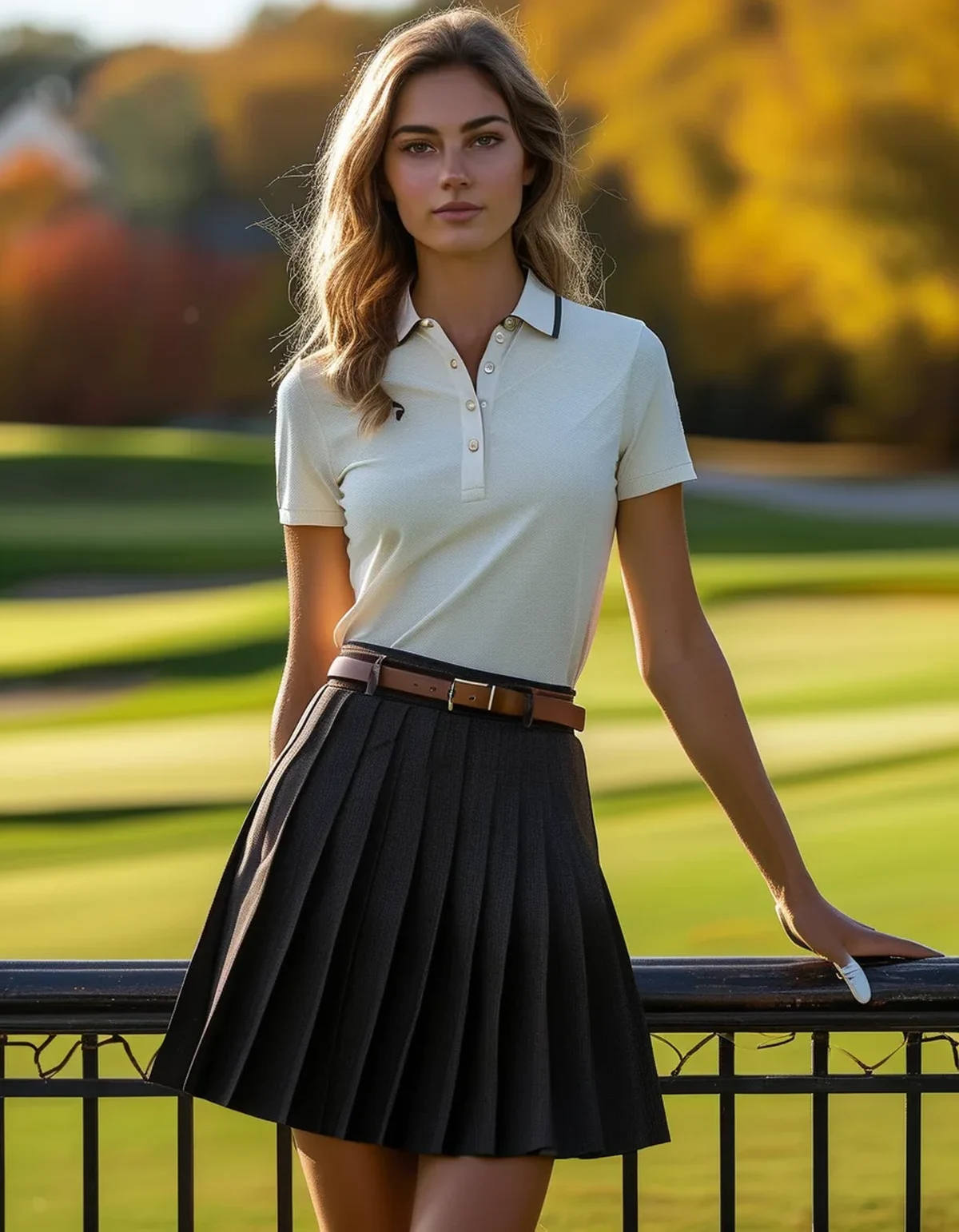
Golfcore skirts and skorts sit longer, commonly just above the knee, and many clubs still have length rules that formalise it. The longer hem changes the whole proportion of the outfit: it reads as tailored rather than athletic, and it works with a tucked top in a way a very short skirt does not.
The rise follows. Golfcore favours a defined high waist with a proper waistband, belt loops and often a belt. Tenniscore is more likely to use an elastic or a soft waistband hidden under the top.
Practical translation: if you own one pleated skirt and want it to read golfcore, wear it with the waistband visible and a top tucked in. Untucked and short, the same skirt reads tennis.
2. Colour, and specifically the role of white
Tenniscore is built on white. Golfcore uses white as one colour among several.
The tennis reference point is the all-white tradition, and even loose interpretations of the aesthetic lean heavily on white with a single accent — a green or navy trim, a stripe at the collar.
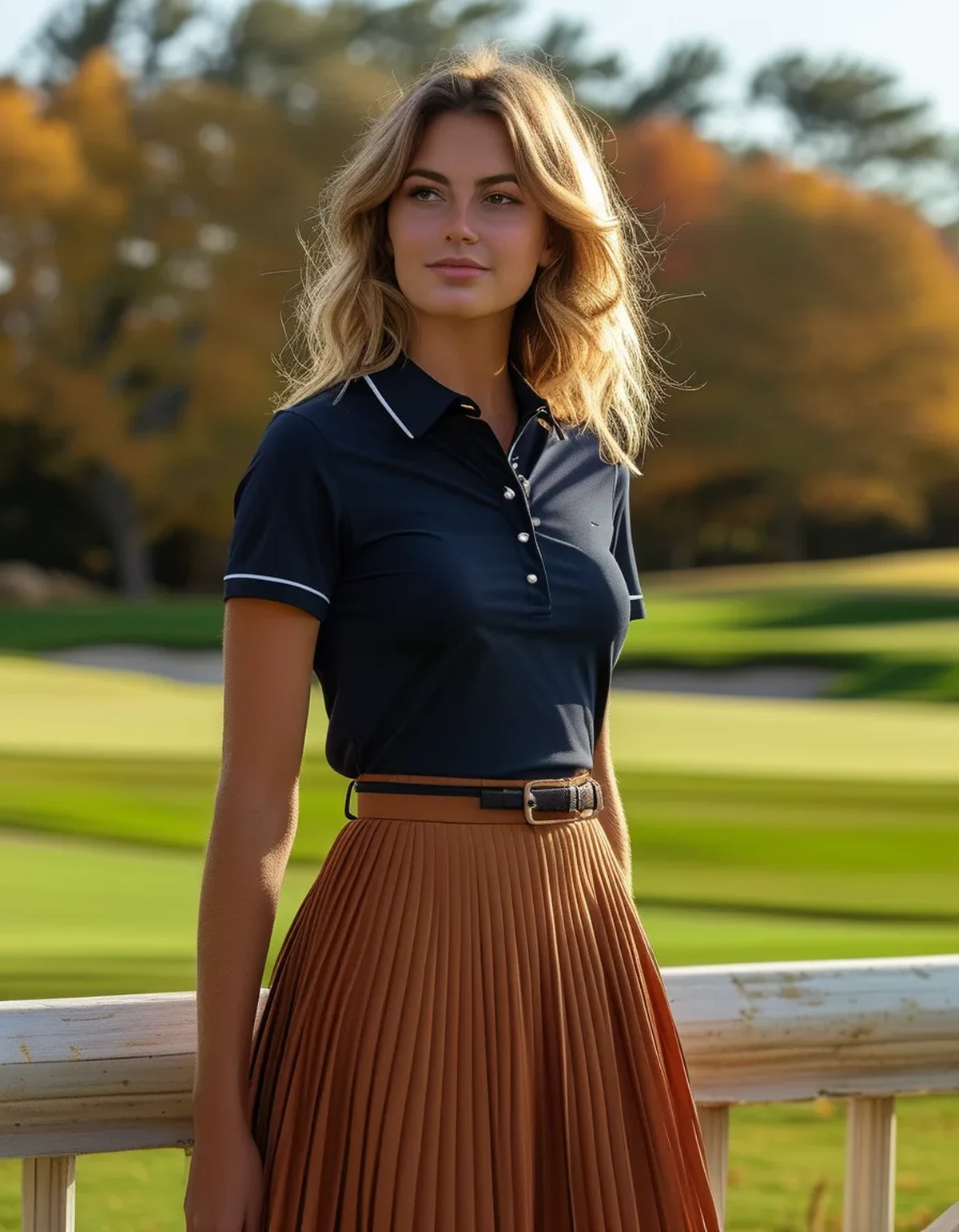
Golfcore’s palette is broader and warmer: cream, camel, forest green, burgundy, navy, tan and pale blue, often several in one outfit. Argyle, tartan and windowpane checks belong firmly to golf and almost never to tennis.
Pattern behaves differently too. Tenniscore pattern is usually a trim or a small repeated motif. Golfcore pattern can be the whole garment — a checked skirt, an argyle vest, a printed polo.
Practical translation: adding one earth-toned or heritage-patterned piece pushes an outfit from tennis toward golf faster than changing the silhouette does.
3. Fabric weight and finish
Tenniscore fabrics are light, matte and performance-coded: technical piqué, light jersey, mesh panels, nylon. The look is cool, fast and summer-only.
Golfcore fabrics carry more weight and more texture: heavier piqué, ponte, milled cotton, merino, brushed knits, twill, corduroy for the outer layers. The finish is often slightly lustrous rather than matte, and there is usually at least one natural-fibre element visible.
This is the detail that most often goes wrong, because a very light technical fabric in a golf colour palette still reads as tennis. Weight communicates season, and golfcore is a three-season aesthetic.
Practical translation: in autumn, weight is the fastest correction available. A merino vest over the same polo changes the reading entirely.
4. Footwear
Tenniscore is a sneaker aesthetic. Full stop — a clean white court shoe, low profile, minimal branding.
Golfcore has a wider and more interesting footwear vocabulary: spikeless golf shoes that read as smart trainers, loafers, driving shoes, and in autumn, a low boot. The common thread is a shoe with some structure and often a leather or leather-look upper.
Sock height is part of it. Tenniscore uses a low or no-show sock. Golfcore accommodates a visible ribbed sock, and in cooler months a crew sock with a skirt is a legitimate and deliberate golfcore move where it would look wrong in the tennis version.
Practical translation: swap a white court sneaker for a loafer and half the outfit reclassifies itself.
5. Layering, and whether there is any
Tenniscore is essentially a single-layer aesthetic. A dress, or a top and skirt. A cardigan draped over the shoulders is about as far as it goes, and it is styling rather than function.
Golfcore is fundamentally a layered aesthetic, because a round of golf spans four hours across a changing morning. The vest, the quarter-zip, the cardigan and the light windproof shell are all core pieces rather than accessories, and they are worn rather than draped.
The sleeveless vest is the single most golf-specific garment there is — it exists because golf needs a warm torso and free arms, which is a requirement almost nothing else has.
Practical translation: if you want an outfit to read unmistakably golfcore, add a vest or a quarter-zip. Nothing else does the job as efficiently.
6. The collar
Both aesthetics use a polo, and they use it differently.
Tennis polos tend toward a small, soft, flat collar or a collarless technical top, often with a scoop or V neckline, in the lightest available fabric.
Golf polos carry a more structured collar that stands, a longer placket, sometimes a johnny collar or a quarter-zip in place of buttons. The collar is meant to hold its shape after four hours of wear and to sit correctly under a vest — which is a design requirement tennis does not have.
Sleeve length differs too. Golfcore comfortably includes a long-sleeve polo and a mock neck; tenniscore almost never does.
Practical translation: a soft flat collar under a chunky vest looks slightly wrong for a reason. Structure at the neck is what makes layering sit properly.
7. What the outfit implies you are about to do
The deepest difference, and the one that explains the other six.
Tennis is an hour of intense movement in one place in warm weather. The clothing reflects a single condition: hot, fast, and finished soon.
Golf is four to five hours of walking outdoors across a morning that starts cold and ends warm, with weather that may change twice. The clothing reflects duration and variability — which is why it is layered, heavier, longer and more structured, and why it accommodates a pocket, a belt and a glove.
This is why golfcore transitions to everyday wear so much more easily. It was already designed for changeable outdoor conditions and a long day, which is also what commuting, errands and autumn weekends require. Tenniscore, taken off the court, is essentially a summer aesthetic.
Practical translation, and the seasonal point: from now through autumn, golfcore is the more useful of the two by a wide margin. As mornings turn genuinely cool, the vest-over-polo, longer skirt, opaque tights and loafer combination works from a 7am start to a 4pm finish. The tennis version of the same outfit stops working entirely once you need a layer, which is roughly this week.
Where they legitimately meet: a pleated skirt in a heritage check with a structured polo, a fine merino vest and loafers is golfcore. The same skirt in white technical fabric with a soft-collar top and court sneakers is tenniscore. The skirt is not the deciding factor — everything around it is.
TL;DR:
- Length and rise: golfcore sits near the knee with a defined waistband; tenniscore sits short with a soft one.
- Palette: tennis is built on white; golf uses heritage colours and lets pattern take over a whole garment.
- Weight: light and matte reads tennis, heavier and textured reads golf. Weight communicates season.
- Shoes and socks: court sneaker versus loafer or low boot, no-show versus visible ribbed sock.
- Layers: the vest and quarter-zip are the fastest way to make anything read golfcore.
One merino vest over a polo you already own does more reclassifying than a whole new outfit.
See It in Motion
Seen here: UPF 50+ Adjustable A-Line Running Skort with Pockets — shop it on bubblelime.com
Keep Reading
This article is for general informational and styling purposes only. Fit, sizing, and product availability may vary.